By clicking Get My Free Quote, I give Goodco LLC (eGoodwin Insurance) and its licensed agents my prior express written consent, by electronic signature, to contact me with calls and text messages — including marketing calls and texts made using automated technology or an artificial or prerecorded voice — and by email, at the number and email I provided, about my insurance quote and related insurance products and services, even if my number is on a Do Not Call list. My information is never sold or shared with other agencies for their own marketing. Consent is not a condition of purchase; I can call (740) 387-8335 instead. Message frequency varies. Message and data rates may apply. Reply STOP to opt out, HELP for help. I agree to the Privacy Policy and Terms of Use, including the arbitration clause and E-SIGN consent.
Maybe your renewal notice came in noticeably higher than last year. Maybe you just closed on a house in Powell and the lender wants proof of insurance by Friday. Or maybe a neighbor’s finished basement took on water last spring, and you realized you don’t actually know what your own policy does with that.
Homeowners insurance tends to get read for the first time on the worst day of the year. This guide is the version you read before that day.
We’ll walk through what a standard Ohio homeowners policy covers, how replacement cost and actual cash value pay out, and why your dwelling limit should track rebuild cost instead of market value.
Then we’ll cover what Ohio policies commonly leave out, how wind, hail, freezes and fallen trees play out on a claim, what drives your premium and how to compare quotes without giving up coverage. We’ve been helping Ohio homeowners with these decisions since 1990, from our offices in Powell and Marion, and we work for you, not an insurance company.
What does a standard Ohio homeowners policy cover?
The short answer: A standard HO-3 policy covers your house, detached structures, your belongings, extra living costs while you’re displaced, your personal liability and small medical bills for guests hurt on your property, each with its own limit.
The Ohio Department of Insurance’s homeowners insurance guide calls the HO-3, or “special form,” the most common homeowners policy today. In plain English, it covers damage to the house itself from any cause that isn’t specifically excluded. Your belongings are usually covered only for the causes the policy lists, so it’s worth knowing which side of the policy a claim falls on.
Most HO-3 policies are organized into six coverages. They show up on your declarations page as Coverage A through F:
| Coverage | What it pays for | What to check |
|---|---|---|
| A · Dwelling | Repairing or rebuilding the house and attached structures, like an attached garage or deck. | Set it at rebuild cost, not market value. |
| B · Other structures | Detached garages, sheds, fences and similar structures on your lot. | Usually a share of Coverage A. Check it if you have a pole barn or large detached garage. |
| C · Personal property | Your furniture, clothing, electronics and other belongings, at home or away. | ODI says this is typically at least 50% of the home’s insured value. Jewelry, firearms and collectibles often have lower sub-limits. |
| D · Loss of use | Extra living costs, like a rental or hotel and meals, while a covered loss makes your home unlivable. | Look for a dollar limit or a time limit. |
| E · Personal liability | Injuries or property damage you’re legally responsible for, plus your legal defense. | ODI’s sample policy shows $100,000. Many households carry more. |
| F · Medical payments to others | Medical bills for guests hurt on your property, regardless of fault. It doesn’t cover you or your household. | ODI’s sample shows $1,000. Small limits are normal here. |
ODI also lists the smaller “after-the-fact” coverages most policies carry: trees and shrubs, temporary repairs, fire department charges, debris removal and coverage for belongings while they’re being moved. They’re small, but they matter after a storm.
Other policy forms. The HO-5 is broader, covering both the house and belongings on an open-perils basis. The HO-8 pays no more than what the home would have sold for the day before the loss, which can fit an older home that would cost far more to rebuild than it’s worth. Condo owners use an HO-6 and renters an HO-4. Our condo insurance and renters insurance pages cover those.
What’s the difference between replacement cost and actual cash value?
The short answer: Replacement cost pays what it takes to repair or replace with new materials of like kind and quality, while actual cash value subtracts depreciation first, so an ACV claim on an older roof or older belongings can pay much less.
ODI’s guide puts it simply: actual cash value (ACV) is generally replacement cost minus depreciation. Its own example is a television that cost $500 new and is worth $100 today. With ACV and a $250 deductible, that claim pays nothing. With replacement cost, the policy pays for a comparable new TV, minus the deductible, though you may need to show proof of the purchase.
The same math applies to your house, and it gets bigger fast. Here’s how the two settle a roof:
- With replacement cost on the roof, the policy would pay up to $17,000 toward the new roof after the deductible, depending on your policy terms.
- With actual cash value, the adjuster first subtracts depreciation for the roof’s age. If the roof is judged to be 60% depreciated, it’s valued at $7,200, and the policy would pay about $6,200 after the deductible. The other $11,800 is yours.
Watch for roof schedules. Some quotes settle the dwelling at replacement cost but pay the roof at ACV, or on a schedule that shrinks with the roof’s age. It isn’t universal, and it doesn’t always show up in the headline price, so ask about it on every quote.
Replacement cost often pays in two steps. Many policies pay the ACV amount first, then release the rest once the repair or replacement is done. Keep your contractor invoices and receipts.
The Ohio Committee for Severe Weather Awareness recommends considering replacement cost coverage for both the home and its contents, so you can rebuild and replace at current prices instead of depreciated values. That’s our default too. Your belongings matter here as well, because a contents policy written at ACV can pay very little for a five-year-old couch.
Should your dwelling limit match your home’s market value?
The short answer: No, your dwelling limit should reflect what it would cost to rebuild the house today with similar materials and labor, which can be well above or below what the house would sell for.
Market value includes the land, the school district and the neighborhood. None of those burn down. Rebuild cost is about lumber, roofing, drywall, labor, permits and debris removal, so the two numbers can drift far apart. A 1920s brick home in Marion with plaster walls and trim work may cost far more to rebuild than its sale price. A newer home on a large lot near Powell may be the reverse.
ODI’s guide shows why this matters on a small claim, not just a total loss. Its example is a house with a $100,000 replacement cost insured for only $60,000. A $1,000 roof claim pays 75% of the repair, or $750, and the $250 deductible brings that to $500. The homeowner covers the other $500 on a claim the policy should have handled.
A few things push rebuild cost up between renewals:
- Remodels and additions. A finished basement, new kitchen or added bathroom raises rebuild cost. Tell your agent when you finish one.
- Building costs. Lumber, roofing and labor prices move. Many policies add an inflation adjustment at renewal, but it’s worth checking the number against a fresh estimate every few years.
- Code upgrades. After a big loss, your town may require current building code on the repair. ODI notes that even guaranteed replacement cost policies may not pay for these “ordinance and law” upgrades unless you add that coverage.
Two endorsements help when a big claim runs past the estimate. Extended replacement cost adds a cushion above Coverage A, often a set percentage, and ordinance or law coverage pays for required code upgrades. Availability and limits vary by company. Your mortgage lender will require at least enough coverage to protect its loan, according to ODI, but its minimum isn’t a rebuild estimate. Our Ohio home insurance page explains how we set dwelling limits with you.
What do Ohio homeowners policies leave out, and what can you add back?
The short answer: Flood, sewer and drain backup, earthquake, wear and tear, and poor maintenance are the common exclusions; flood needs a separate policy, while water backup, earthquake and, in some counties, mine subsidence can be added to many homeowners policies.
ODI’s guide lists the typical exclusions on homeowners forms: earthquake, flood, water damage from sewer backup or basement leaks, power failure off the premises, poor maintenance, war, nuclear hazard and building code enforcement. Here’s what that means for an Ohio house:
Flood
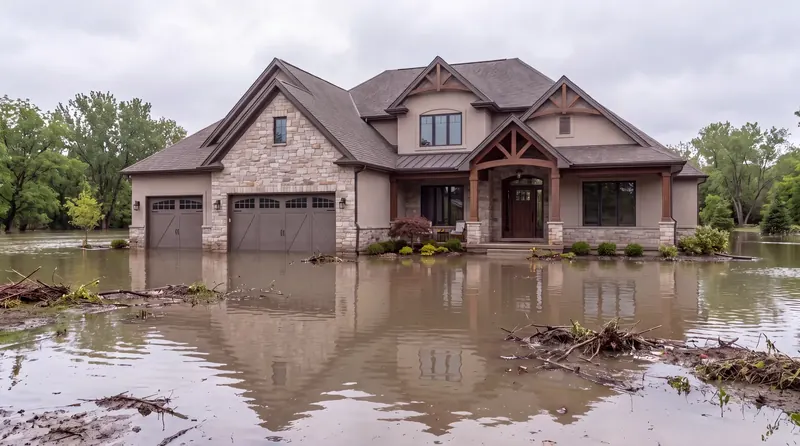
Rising surface water isn’t covered by a standard homeowners policy. FEMA’s National Flood Insurance Program flyer (October 2024) says a standard homeowners policy typically does not cover flood damage. The NFIP can write up to $250,000 on the building and $100,000 on belongings.
There is typically a 30-day waiting period before a new policy takes effect, so it can’t be bought the day the river rises. FEMA also says about one-third of NFIP claims from 2013 to 2023 came from outside current high-risk flood areas. Our flood insurance page covers the details for central Ohio.
Water backup and sump pump failure
This is the gap we see most in Ohio. ODI’s Severe Weather Toolkit says water backup in the basement isn’t typically covered and must be added, and that sewer and drain backup is excluded or limited in most policies. If your sump pump fails in a spring storm or the city sewer backs up through a floor drain, the claim usually turns on whether you added a water backup endorsement, and how high its limit is.
Earth movement
Earthquake damage requires an endorsement, according to ODI. The guide notes earthquake deductibles are typically 2% to 5% of the insured replacement cost, and brick homes generally cost more to cover.
Mine subsidence is an Ohio-specific twist. Under Ohio Administrative Code rule 3901-1-48 (effective February 14, 2022), homeowners policies in 26 counties, mostly in eastern and southeastern Ohio, must include mine subsidence coverage. In 11 more counties, including Delaware County, insurers must offer it on an optional basis.
In plain English: if you live in Powell or anywhere else in Delaware County, your company has to offer it, and you decide. The coverage pays up to your dwelling limit or $300,000, whichever is less, with a deductible between $250 and $500. The rule caps the yearly premium at $20 in the optional counties.
Wear, tear and maintenance
Homeowners insurance pays for sudden, accidental damage. A roof that has slowly worn out, a pipe that has leaked behind a wall for months or a deck that has rotted generally isn’t covered.
Food spoilage is a smaller gap. ODI says losing the food in your fridge or freezer to an off-site power outage usually isn’t covered, though some companies offer a refrigerated property endorsement.
By clicking Get My Free Quote, I give Goodco LLC (eGoodwin Insurance) and its licensed agents my prior express written consent, by electronic signature, to contact me with calls and text messages — including marketing calls and texts made using automated technology or an artificial or prerecorded voice — and by email, at the number and email I provided, about my insurance quote and related insurance products and services, even if my number is on a Do Not Call list. My information is never sold or shared with other agencies for their own marketing. Consent is not a condition of purchase; I can call (740) 387-8335 instead. Message frequency varies. Message and data rates may apply. Reply STOP to opt out, HELP for help. I agree to the Privacy Policy and Terms of Use, including the arbitration clause and E-SIGN consent.
How does a homeowners policy handle Ohio storms, winter freezes and fallen trees?
The short answer: Wind, hail, tornadoes, lightning and the weight of ice and snow are usually covered after your deductible, but a separate wind/hail deductible can raise what you pay, and freeze and ice-dam claims often depend on how the home was maintained.
Ohio gets the full calendar of weather: spring and summer thunderstorms with hail, straight-line winds and tornadoes, then ice, snow and deep cold in winter. Nationally, wind and hail made up 42.5% of homeowners insurance losses in 2023, and water damage and freezing another 22.6%, according to ISO data published by the Insurance Information Institute. Those are national figures, but they match the calls Ohio agents get after a storm.
Usually covered
The Ohio Committee for Severe Weather Awareness says tornado losses are most often covered by the windstorm peril on a homeowners policy, after your deductible.
Covered, watch the roof terms
Hail damage to roofs and siding is a common storm claim. How the roof settles, at replacement cost or ACV, can matter more than the deductible.
Sudden bursts, usually yes
A pipe that freezes and bursts is usually a covered water claim. Many policies expect you to keep the heat on, or shut off and drain the water if the home sits empty.
Interior damage, often yes
Water forced under shingles by an ice dam can damage ceilings and walls. Interior damage is often covered. Repeated leaks from a worn roof may be treated as maintenance.
Covered when they hit something
ODI says a tree falling on your home, garage or fence typically triggers repairs and tree removal. Debris removal may be limited if it hit nothing, and replacing the tree usually isn’t covered.
Not covered
Storm water that rises and flows into the house is flood. That needs a separate flood policy, whatever caused the storm.
Fallen trees, in more detail. If a storm drops your neighbor’s tree on your garage, your own policy usually handles your garage, and your neighbor’s policy isn’t automatically on the hook. A tree that falls across the yard without hitting anything may get limited or no removal coverage, depending on the policy. If you have a dead or leaning tree near the house, taking it down before a storm is usually cheaper than a claim.
How deductibles work, including wind and hail deductibles
Your deductible is the amount you pay before insurance pays. ODI calls raising it the simplest way to lower your rate, as long as you could afford to pay it. But Ohio homeowners need to read the deductible line closely, because there may be two.
ODI’s Severe Weather Toolkit says many policies carry a separate wind/hail deductible, written either as a flat dollar amount or as a percentage of the insured value. A percentage deductible is easy to misread:
- A kitchen fire would carry the $1,000 deductible.
- A hail claim on the roof would carry a deductible of 2% of $350,000, or $7,000.
A percentage deductible can bring the premium down, and for some households that trade is worth it. Just make the choice on purpose. When we compare quotes, we put each deductible in dollars so you can see what a storm claim would actually cost you.
What drives the cost of homeowners insurance in Ohio?
The short answer: Your location, the home’s age, construction and condition, how much coverage you buy, your deductibles and endorsements, distance to fire protection, and your claims and credit history all move the price.
ODI regulates homeowners insurance but doesn’t set your rate. Each company files its own rating plan and weighs the factors its own way. ODI’s guide lists the main ones:
Policy type and limits
The policy form, the amount of coverage and the extra coverages you add all move the premium.
What you pay first
Higher deductibles lower the premium. That includes a percentage wind/hail deductible.
Where the house sits
Storm history, claims in the area and local building costs differ between a Columbus suburb and rural Marion County.
Type, age and condition
ODI notes frame homes usually cost more to insure than brick. Roof age and condition matter to most companies.
Hydrants and stations
Distance to the nearest fire hydrant and fire station affects the rate.
Claims and credit
Many companies use an insurance score. ODI says credit can’t be the sole reason for a rate increase.
What about an Ohio “average”? Ohio homeowners paid about $4.68 billion in homeowners premiums in 2024, the 10th-largest total in the country, according to the NAIC’s 2025 Ohio market key facts. The averages you see quoted online usually price one sample house at one set of limits. Your home, ZIP code, roof and deductibles can put your price well above or below any of them, so we don’t lead with a single number.
Discounts are real, but they vary by company. ODI lists bundling home and auto with one company, home alarm systems, a newly built home and a claims-free history. Some companies also credit a newer roof or protective devices. Ask which discounts you’re actually getting. Bundling is often the biggest one, and our Ohio car insurance guide covers the auto side of that conversation.
Claims history follows the house and the owner. ODI notes that two or three claims within five years may lead a company to cancel or not renew. That’s one reason to think twice before filing a claim only slightly above your deductible. Talk it through with your agent first.
How do you compare Ohio homeowners insurance quotes like-for-like?
The short answer: Quote every company at the same dwelling limit, the same deductibles, including any wind/hail deductible, and the same endorsements, then compare roof settlement terms and liability before price.
Two homeowners quotes at different prices are rarely the same coverage. One may have a lower dwelling limit, ACV on the roof, a 2% wind/hail deductible or no water backup. ODI’s own advice is that “the policy offered at the lowest cost may not offer the level of insurance protection you need.” That’s exactly the work an independent agency does. We quote the same coverage across our lineup of companies, then walk you through the differences, in this order:
- Start with your current declarations page
It lists your dwelling limit, the other coverages, deductibles, endorsements and premium. Use it as the baseline, so every change from it is on purpose.
- Set the dwelling limit to rebuild cost
Use a current replacement cost estimate, not the sale price or tax value. Then quote every company at that same number.
- Match every deductible, in dollars
Line up the all-perils deductible and any wind/hail deductible. A 1% or 2% wind/hail deductible on one quote and a flat $1,000 on another isn’t a fair comparison.
- Read the roof and contents terms
Ask whether the roof settles at replacement cost or ACV, and whether your belongings are covered at replacement cost.
- Match the endorsements
Water backup and its limit, extended replacement cost, ordinance or law, and scheduled jewelry or other valuables. If one quote leaves them off, it isn’t the same policy.
- Size liability to what you own
ODI’s sample shows $100,000. Many households choose $300,000 or more, and an umbrella adds a layer above that.
- Check the company, too
ODI suggests confirming that a company is licensed in Ohio and checking financial strength ratings from firms like AM Best. ODI doesn’t rate or recommend companies.
For households with real assets, an umbrella policy adds liability protection above both your home and auto limits. Bundling home and auto may lower what you pay, too. Eligibility and discounts vary. The best time to compare is a few weeks before renewal, or before a big change like a remodel, a new roof or a move.
What if your company drops you, or no company will insure your home?
The short answer: Start with an independent agent who can shop more than one company; if the regular market still says no, the Ohio FAIR Plan is the last-resort option, and ODI’s Consumer Services line at 800-686-1526 can help with complaints.
A nonrenewal letter is stressful, especially after a claim or a roof inspection. It doesn’t mean your home is uninsurable. Different companies have different appetites for older roofs, prior claims and older homes, which is one of the main reasons people come to an independent agency.
- A company generally has to give you at least 30 days’ written notice before cancelling, and the notice should explain how to apply to the FAIR Plan. That notice period doesn’t apply to nonpayment, arson, misrepresentation or fraud.
- Two or three claims within five years may lead to cancellation or nonrenewal.
- If you can’t resolve a problem with your agent or company, ODI’s Consumer Services Division takes calls at 800-686-1526.
The Ohio FAIR Plan is the state’s residual market for property the regular market won’t insure. Under Ohio Administrative Code rule 3901-1-18 (effective April 1, 2025), it offers basic property and homeowners coverage to people who have been unable to get it in the normal market. Applicants generally have to show that at least two licensed companies have declined, and the property has to meet the plan’s underwriting standards, which can include an inspection.
ODI’s guide is direct about the trade-off: you don’t have a guaranteed right to FAIR Plan coverage, and it’s likely to cost substantially more. Any licensed agent can help with the application, and we do.
Worth watching. House Bill 652 in the 136th General Assembly would require insurers to give homeowners at least 60 days’ notice of a nonrenewal, with an explanation of the reason available. As of November 2026 it had been introduced and referred to the House Insurance Committee, according to the Ohio House. Nothing has changed yet. We’ll update this guide if it moves.
The bottom line
A homeowners policy is a set of decisions, not just a price. The ones that matter most for an Ohio house are a dwelling limit set at rebuild cost, replacement cost on the house, roof and belongings, a water backup endorsement that fits your basement, a separate flood policy if water can reach you, and deductibles, including wind/hail, that you could pay tomorrow.
Live near one of our offices? We also have local home insurance guides for Powell, Marion, Dublin, Westerville and Delaware, with the flood, basement and county details that matter in each town.
If you’d like a second set of eyes, send us your ZIP below or call (740) 387-8335. We’ll read your declarations page with you, flag the gaps, and quote the same coverage across our lineup of companies, with your auto policy too if you’d like to see a bundle.
Some clients have saved up to 36% when we re-shopped their coverage. Savings vary by household and aren’t guaranteed. You can also start on our home insurance page or stop by our Powell or Marion office, Monday through Friday from 9 to 5.
By clicking Get My Free Quote, I give Goodco LLC (eGoodwin Insurance) and its licensed agents my prior express written consent, by electronic signature, to contact me with calls and text messages — including marketing calls and texts made using automated technology or an artificial or prerecorded voice — and by email, at the number and email I provided, about my insurance quote and related insurance products and services, even if my number is on a Do Not Call list. My information is never sold or shared with other agencies for their own marketing. Consent is not a condition of purchase; I can call (740) 387-8335 instead. Message frequency varies. Message and data rates may apply. Reply STOP to opt out, HELP for help. I agree to the Privacy Policy and Terms of Use, including the arbitration clause and E-SIGN consent.
Ohio homeowners insurance FAQ
Is homeowners insurance required in Ohio?
Ohio law doesn’t require you to carry homeowners insurance, but if you have a mortgage, your lender almost always will. The Ohio Department of Insurance notes that lenders typically require coverage of at least the loan amount. Even with the house paid off, going without is a big risk: a single fire, tornado or liability lawsuit could cost far more than years of premiums. A homeowners policy also carries personal liability coverage, which protects your savings if someone is hurt on your property.
Does homeowners insurance cover a flooded basement in Ohio?
It depends on where the water came from. Water from a burst pipe is usually covered. Water that backs up through a floor drain or overflows from a failed sump pump usually isn’t, unless you added a water backup endorsement, which the Ohio Department of Insurance says must typically be added. Surface water that flows in from outside is flood, which needs a separate flood policy. The National Flood Insurance Program covers up to $250,000 on the building and $100,000 on belongings, typically after a 30-day wait. If your basement is finished, ask about both.
Does homeowners insurance cover a tree that falls on my house?
Usually, yes. The Ohio Department of Insurance says that when a tree falls on your home, garage or fence, a homeowners policy typically pays to repair the structure and contents and to remove the tree, after your deductible. If the tree falls without hitting anything, debris removal may be limited or not covered. Replacing the tree itself typically isn’t covered unless lightning caused the damage. If a storm drops your neighbor’s tree on your house, your own policy usually handles your repairs. A separate wind/hail deductible may apply if wind brought it down.
How much homeowners insurance do I need in Ohio?
Insure the house for what it would cost to rebuild today, not what it would sell for. The Ohio Department of Insurance says most policies expect you to insure at least 80 percent of replacement cost, and falling short can reduce what even a small claim pays. Rebuild cost depends on size, materials, finishes and local labor, so start with a current replacement cost estimate. Then set personal property high enough to replace your belongings, liability high enough to protect your savings and home equity, and consider extended replacement cost and ordinance or law coverage for a major loss.
What is the Ohio FAIR Plan?
The Ohio FAIR Plan is the state’s last-resort property insurance market for homes the regular market won’t insure. Under Ohio Administrative Code rule 3901-1-18, effective April 1, 2025, it offers basic property and homeowners coverage to owners who have been unable to get it elsewhere, generally after at least two licensed companies have declined. The property must meet the plan’s underwriting standards and may be inspected. The Ohio Department of Insurance says you have no guaranteed right to FAIR Plan coverage and that it is likely to cost substantially more. A licensed agent can help you apply.
Does homeowners insurance cover hail damage to my roof?
Hail is usually a covered peril on an Ohio homeowners policy, but what you collect depends on two lines in your policy. First, the deductible: the Ohio Department of Insurance says many policies carry a separate wind/hail deductible, either a flat dollar amount or a percentage of your insured value. A 2 percent deductible on a $350,000 dwelling limit means $7,000 out of pocket. Second, the roof settlement: some policies pay replacement cost, while others pay actual cash value, which subtracts depreciation for the roof’s age. Ask about both before you buy.
Last reviewed by Mark Goodwin on .